Even after getting certificate from Count and Countess
things did not change and Orffyreus remain dissatisfied over the arguments about performance of his wheels at Gera. He was
much sensitive to the criticism, which was baseless and unnecessary. Bessler's
critics in scientific circles argued that his wheel could not be perpetual motion simply because according to the known laws
of nature it was impossible - therefore he must be a fraudster. Some undermined the invention by passing the judgment that
power generated by the wheel was not enough.
Inquisitor Warfalcon of Ultima remaks:
“Oddly enough, the burghers of Gera do not seem to have been impressed by his demonstrations.
It may simply be that they were not sufficiently versed in mechanics to realise that he was offering them an invention that
could transform the world! (If rediscovered today, his secret would enable us to dispense with coal, oil and atomic energy.)
Or it may have been simply that Orffyreus was a singularly irritating person, self-assertive,boastful and dogmatic. At all events, he made far more enemies than friends, and soon had to move on.”
To respond to irrational criticism, Orffyreus made up his mind to construct a larger version of the wheel with enough power
such that would convince leading scientists, engineers and officials of his time that he made an important discovery and then
they would recognize him as a remarkable inventor. But we know that every new design and construction of the machine needs
time, money, and effort. Orffyreus had limited resources, which impeded his plans. Moreover, his greatest worry was to keep
cheats away from his invention. It was not possible for him to build perpetual motion machine once for all and leave it to
prying eyes of them. He also realized that it would be very difficult to build main parts of the machine again and again.
For this reason he constructed his wheel in such a manner that it could be dismantled easily into parts that horses could
carry. He already knew a lot about joints and assembly and constructed his wheel accordingly. In this manner he was able to
save the labor and to keep cheats away. Dismantling the machine into parts after
demonstration was over was a right strategy, which Orffyreus adopted through out his career. After dismantling the machine,
he left Gera with regret but with new hope. He decided to move to Drawtsich, close to Leipzig, where he knew wood was cheap,
and was easy to find. In 1714 he constructed a still larger wheel in the town.
Draschwitz Wheel (1714 ) at a Glance
Time : January 1714
Diameter = 9.3 feet
Thickness = 6 inches
Speed = 50 RPM unloaded
Rotation = uni-directional, required restraint when
motionless
Axle = 6 inches diameter (probable diameter
= 1/4 ell =
5.6 inches)
Sound = loud noise
Power = not calculated
size in ell units: reported diameter = 5 ell = 9.3 feet;
probable thickness =1/4 ell = 5.6 inches
In January 1714, Orffyreus wonderful device was ready
for public display again at the inventor’s home in Draschwitz, Germany. It was 9.3 feet in diameter and 6 inches thick
and rotated at fifty revolutions per minute. This wheel rotated about a horizontal axle and produced enough power to lift
100 pounds.
As I have already mentioned, this larger and more powerful
wheel was built to counter the criticism that his previous wheels were too small and weak to be of practical value. . Slowly but surely, news of Orffyreus' invention began to spread. His fame spread far
and near in Europe. His invention created a big stir in the public and people from different corners and all the walks of
life thronged to watch the miracle.
As
Orffyreus troubled fortunes would have it, the news about the machine also reached to Andreas Gärtner, Borlach and Wagner
who were later to become Orffyreus’ mortal enemy. Since Gärtner was Master-Mechanic to the Court of the Polish king,
he had an influence in technical circles. He himself claimed to build tricky, intricate machines, and considered himself to
be a authority in mechanics. He believed that he understood everything there was to know about mechanics. “He believed
that Nature was as he conceived it and only what he knew could exist.” Remarks Eagely .
He believed that perpetual motion was beyond the reach of a puny man like Orffyreus who had no formal training in mechanics.
Orffyreus’ claim to invent a perpetual motion was totally objectionable to him. Gärtner wrote a number of letters to
Orffyreus with a hope that Orffyreus would answers his questions about the working mechanism of
the machine. Orffyreus was well aware of intentions of the person like Gartner who could maneuver in every possible manner
to steal the great secret so he didn’t give much credence to Gartener’s irrelevant queries on the structure of
the machine. However in his reply to Gartner, Orffyreus again claimed that
his device could operate perpetually and lift big loads without any input of energy.
However, Orffyreus was unmindful of the fact that it would offend Gartner much up to the extent of hatching a conspiracy
against him that would damage his plans.Now it became intolerable for Gartner to see Orffyreus’ popularity
increasing day by day. He became so envious of Orffyreus that he decided to discredit
Orffyreus with all malicious intentions. Gärtner’s hatred toward Orffyreus and his invention grew to such unprecedented
dimensions that he decided to take help of other men for launching an active campaign against Orffyreus. Other men who actively
joined this malicious campaign were Borlach and Wagner. They persuaded everybody around them to consider Orffyreus as fraud.
All of them intensified their campaign to discredit Orffyreus. They decided to go to any length to discredit Orffyreus and his invention. They published a fake pamphlet that depicted the wheel driven through hollowed-out
support posts.
Witnesses of Draschwitz Wheel 1714
In Draschwitz few noblemen also appeared amongst the visitors. Among them a court cleric Buchta and a mathematician
Gottfried Teuber (1656 - 1731) took great interest in Orffyreus’ machine and desired to see the demonstration. Orffyreus
gave them appointment and demonstrated his machine. Both were happy.
Teuber and Buchta were amazed to
see the performance of the machine. They saw wooden planks covered the machine to conceal the mechanism. The axle was also wooden, and extended one foot beyond the wheel. It had three teeth. While machine was moving, it was lifting and dropping three wooden stamps continuously, similar to those
used in pounding mills. Teuber and Buchta approached stamps and found to
their satisfaction that they were quite heavy. The iron journals moved in open
bearings so as to prove that neither deception nor an external energy supply were necessary to the machine's motion. Both
visitors were convinced that Orffyreus machine was genuine. For sometime, they discussed with Orffyreus about his machine
and his plans. At this point, Orffyreus, found right opportunity to disclose his future plans. Bessler expressed his desire
to sell his secret for the sum of 100,000 Thalers*an amount equal to 20,000 English Pounds to overcome
his financial hurdles. This was a huge amount, which is nearly equivalent to approximately 2.5 million US dollars today. He
tried hard to assure his visitors that if his wheel was not as he claimed, a true perpetual motion machine, the buyer could
take back their money and his head should be chopped off.
Teuber and Buchta, both were impressed
with Orffyreus and they promised that they would help him in his mission. Teuber
and Buchta were friends of Leibniz and by using their influence in Royal circles it was not difficult for them to help Orffyreus
to fulfill his ambitions. On 19 January 1714, Teuber, wrote the following letter
to Leibniz:
“...I have some very important news for you. A man
of the medical profession, called Orffyreus, has constructed an alleged perpetual motion machine in the nearby village of
Draschwitz, to which he recently moved. This machine was shown to Mr. Buchta and I. It is a hollow wheel of wood, ten feet
in diameter, and 6 inches thick. It is covered by thin wooden planks in order to hide the internal mechanism. The axle is
also wooden, and extends one foot beyond the wheel. It has three teeth which are for moving three wooden stamps similar to
those used in pounding mills. The stamps are quite heavy and are lifted and dropped continuously. The iron journals move in
open bearings so as to show that neither deception nor an external energy supply are necessary to the machine's motion.
Having made an appointment with the inventor, we approached the machine
and noticed that it was secured by a cord to the rim of the wheel. Upon the cord being released, the machine began to rotate
with great force and noise, maintaining its speed without increasing or decreasing it for some considerable time. To stop
the wheel and retie the cords required tremendous effort. The inventor is asking for one hundred thousand Thalers** to reveal the mechanism or to sell the machine. What does Your Excellency think of
this machine?”
Teuber’s
letter was a sensational news to Leibniz. He could not believe it. On 21st
February 1714 Leibniz replied with the following remarks:
“…I cannot believe
that someone has invented perpetual motion. In my opinion, it is contrary to nature’s laws. I suspect that what you
saw in the wheel was the action of highly compressed air. However, it would need to be recompressed after a short time. If
the machine were able to show continuous movement for 24 hours whilst under lock and seal; or in the presence of witnesses
could remain in motion for 24 hours without any additional input of energy, and if it could still apply great force, for example
lifting heavy stamps, it might be very interesting. But even then the motion might not be purely mechanical, but rather, physical
[i.e. non-mechanical]…”
Orffyreus mysterious machine puzzled his mind very much. He became anxious
to get more information about it. For this reason, a month later Leibniz wrote another letter to Teuber, in which he enquired
only about the device:
“Previously I wrote
to you and Mr. Buchta that I do not believe that mechanical perpetual motion is possible, however it seems to me that if a
machine has been made which could remain in motion for 24 hours and still show a force comparable to that of several men or
a couple of horses, then it could still be of great importance – even if it needed its power restored after 24 hours.
So if you saw such a machine in the village of Draschwitz, then it is of great value. I think it would be beneficial if several
trustworthy men could witness and testify that the machine was observed in continuous operation for 24 hours.”
Leibniz wanted a scientific description that would remove his doubts and enable
him to judge the machine properly. Especially, he emphasized the importance of
concrete measurements so that he could guess about the motive power of the machine which would also help him to ascertain the value of the machine and its scope. With great attention and curiosity, Leibniz was looking forward to get further letters
from Teuber and Buchta.
On
15th April, 1714 Buchta wrote the following lines:
“Mr. Orffyreus has
no objection to running his machine for four weeks, in order to test it! He also asked me to find out if Your Excellency would
be willing to buy the machine on behalf of some great prince. He is a quite extraordinary man and it is well worth Your Excellency
taking the trouble to see him when Your Excellency visits us. It is only an hour’s travel from Zeitz.”
On 26th April 1714 Teuber
wrote another letter with greatenthusiasm.
“I come now to the
inventor of the perpetual motion machine and the test of its movement. The inventor assures us that it could run, not just
for 24 hours, but for a whole month! The machine is utterly amazing! Of course, I cannot decide what principle lies behind
it, but I am certain that it is not moved by compressed air contained within it, because there are many slits in the wheel.
The increase in its power depends on an increase in its diameter. The model which I saw and which can still be seen in the
village of Draschwitz is 10 feet (3m) in diameter and has the power to lift about 100 pounds (45kg).”
Leibniz replied this letter in May, 1714, but he was still very careful and
skeptical about Orffyreus’ machine:
“Thank you very much
for all that you have told me about the machine at Draschwitz. To make sure that everything that you have told me is correct,
you should consider the following. Open slits do not necessarily mean that compressed air is not inside, because the external
surface need not form the container into which the air has been compressed. Compressed air alone would be insufficient; there
must be some other means of applying force to restore the machine to its previous state: I would not dare recommend the purchase
of the machine as a great invention, to any great prince, before I or some other reliable and experienced person had examined
it. However, if it is what it claims to be, I think it could be of great importance and worthy of support and reward. I am
very pleased to hear that my calculating machine is progressing well.”
A
few weeks later Leibniz wrote another letter and requested for further details about Orffyreus’s wheel.
“If your Orffyreus’ machine contains a strong internal
force that can last for several hours or even days, I cannot see any other possibility than compressed air being inside it.
I am sure that the thin wooden covering cannot contain air, but that does not mean that there is nothing under it that can
do so. Certainly, mechanical perpetual motion stemming from such a source is impossible; in which case the source of the force
must be outside. If one excludes animals, water, wind, remote weights, a servant rotating it from
inside, which is not suitable for lengthy operations – it seems to me that only air remains. However, we will not be
sure until it has been examined. If the inventor can fulfil his promises, I am sure he can expect the sum of money he is asking
for.”
Teuber was again prompt to reply Leibniz
on this matter. On 30th July Teuber wrote:
"I do not know what to
say or think about the Orffyrean machine. The effect is clearly evident but the real cause is hidden. What is so odd about
the machine is that it is moving together with all its parts, including the axle. I would support your hypothesis that the
only moving agent could be compressed air, but for the fact that the external source necessary for this is absent. The air
contained within is, in my opinion, not sufficient to drive the machine. So even though your theory seems to be the only possible
one, doubts still remain. In the meantime, many spectators from different places have come to see the machine, and some are
of high standing. Our Serene Highness (Moritz-Wilhelm, Duke of Zeitz) saw it recently with his own eyes, and greatly admired
it. I discussed it with several interesting and educated people from Prussia, Brandenburg
and Saxony. They were all very enthusiastic about the machine. I would be very pleased if Your Excellency could examine it
as soon as possible."
After this, on 14th August Leibniz wrote the following letter to Teuber again showing his interest to precisely know about power
of Orffyreus machine:
“I would like to calculate how much
force is exerted by the Orffyrean machine. In other words, how heavy a weight can it lift? How high and how many times an
hour? And as well, how many days can it run continuously without interruption? It should be rigorously examined in order to
exclude any possibility of fraud involving the application of some hidden force. His Serene Highness (the Duke of Zeitz)
wrote to me indicating that he intended to make a more careful, thorough examination of it. It is true that air alone
cannot move anything without something from the outside either propelling it or resisting it. As all other possibilities
have been excluded, the air can only come from outside the machine. God-willing, I shall leave Vienna before the winter for
Hanover. I will try to see you on my way and so we will be able to discuss everything then.”
Leibniz visited Zeit and stayed there between
9th and 12th September 1714. Here though he was busy, he did not forget to visit Orffyreus’ machine
on his way back from Vienna to Hanover. Leibniz could witness the demonstration of Orffyreus machine only for 2 hours as he was traveling in the coach with a gentleman of the Duke of Zeitz. After this, Leibniz wrote a letter to Erskin, Peter the Great’s court physician. Thanks to Erskin, Leibniz’s letter about this
visit is extant.
Leibniz wrote:
“Orffyreus is a friend of mine, and he
allowed me, sometime ago, to carry out some experiments with his machine. It
ran continuously for two hours in my presence and demonstrated considerable power. However, I could not remain there to observe
it moving any longer because I was travelling in the coach with a gentleman of the Duke of Zeitz. I advised him to arrange
a test in which his machine would be run for several weeks with all possible precautions taken to exclude any suspicion of
fraud. At the same time, data could be obtained about the machine’s performance and its power. Once this has been accomplished
I am sure that several princes could combine their resources, as he requests, in order to pay him a worthy recompense for
his invention. Even if this device is not a perpetual motion machine, about which there is so much talk at the present time,
it would still be of great use if it could pass this test of several weeks. He has promised me that he will arrange such a
test.”
After this visit, when Leibniz went
to Hanover, he was shocked to learn that, King George refused him to take him on to England. To Leibniz’ great disappointment,
King penalized him heavily. He also refused to give Leibniz any payment because he had stayed in Vienna without his permission.
While Leibniz was staying in Hanover,
he wrote the following:
“There is something
extraordinary about Orffyreus’ machine: we must not ignore it, because it could bring tremendous benefits. If it was
proved. after thorough examination, that a wheel of larger construction could do useful work, and if it could be used, for
example, to drain water from a mine, then I think it would be wise to offer the inventor a considerable sum of money. This
money could be paid, either in a single payment or over a relatively short period of time. So as to benefit both public and
inventor, the following considerations should be born in mind:
1.
A thorough examination must be carried out to ensure that a larger machine will be of benefit. This is to exclude the
possibility of anyone laying himself open to a charge of malpractice at Court by recommending an unreliable device.
2. An agreement should be
reached with the inventor for a certain sum of money to be paid to him, if possible, and which he will stand firm on.
3. It would be advisable to pay him immediately some of the money as an interim measure for his subsistence, and
to pay him a yearly pension until the time comes for him to receive the complete reward".
On 23rd September 1714
Leibniz wrote to Teuber:
“I wish Orffyreus could
be released from the burden of supporting all of his family and friends, who are of little help to him. Through the kindness
and persuasion of His Serene Highness [Moritz-Wilhelm, Duke of Zeitz] this could be achieved. I hope he will help him, because
his invention merits it. I want him to move his machine to the Zeitz region. Doing this will ensure the safety of this matter
for the future. Will you discuss this with Court Councillor Buchta?”
Leibniz wrote to Duke Moritz-Wilhelm
on 7th October, 1714:
"I believe that Orffyreus’ invention is very important and I would like it to be utilized
and the sooner the better. I am thinking of certain applications in the mining industry. At present he lives under the burden
of some people who, it appears, are not acting with his benefit in mind. So I think it would be
advisable to consider how to free him from that burden. Whatever is decided, it would be wise to take steps to ensure that
he is not pressured into moving to another area simply because he is not faring well here – somewhere where he could
more easily be deprived of the fruits of his invention. If your Serene Highness, in Your generosity, could assure him of a
sufficient subsistence for a short while, I would hopefully find, in the meantime, a suitable course of action leading
to a deserving reward for Orffyreus and the public employment of his wheel. I am writing to Court Councillor Buchta and the Court Pastor Teuber about this matter also, as they can provide you with the best
assistance in this matter."”
Leibniz
wrote letters requesting rulers to help Orffreus but he himself never believed in the
fact that perpetual motion was possible Instead he suspected that machine derived its motive power from compressed gas inside
the machine. Because of this Orffyreus remained skeptical about Leibniz’
efforts to help him.Leibniz’s efforts were not much fruitful because Orffyreus developed maladjustment in his personality
due to various tensions at his time. Owing to some adverse circumstances, Orffyreus
decided to move away to another place together with his family. He dismantled his machine into pieces again and left Draschwitz
at the end of November 1714. After spending winter in a nearby village, he then traveled to Merseburg in spring, which was
18 miles (30km) distant from Leipzig.
After Orffyreus came to Meseburg, news about his
Draschwitz wheel was spreading fast.
In January 1715, in the journal Acta Euditorium, a short scientific article about his perpetual motion wheel was published
by Leibniz’ student, Christian Wolff. He wrote in Acta Eruditorum:
“...A perpetual motion has been built by Orffyreus, a man
skilled in the art of Medicine, from which he derives a living; and in Chemistry and Mechanics in which he is versatile...
the perpetual motion which our Orffyreus built, has been seen by thousands of people, including experienced mathematicians
and mechanics and they were all full of admiration. The mechanism, for which the inventor expects a sum of money, is carefully
hidden, and is said to be simple. The diameter does not exceed five Leipzig ells (9.3 feet) nor does it exceed six inches
in thickness. Over a period of one minute, fifty revolutions were observed and the wheel rotated whilst freely suspended with
no apparent external source of power. It can provide impulse to remote mechanisms and easily lift weights of sixty to seventy
pounds to a considerable height, in a repetative, equable and continuous movement. This noble invention has been displayed
to the public by the inventor in the village of Draschwitz, not far from the town of Zeitz; but he is considering moving to
a new location.”
REFERENCES:
* (See J. Collins’ book Perpetual
Motion : An Ancient Mystery Solved ? -pp. 54, 102, 123, 137, 141, 159, 171).
**
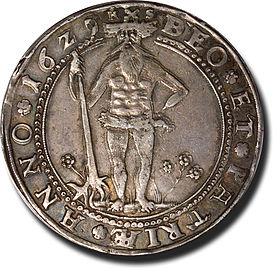
A Thaler was a silver coin, named after a silver mine in Bohemia, from which probably the word “dollar” has
been derived. See below picture of 17 century German Thaler